The Growing Debate Around AI Safety and Governance
Artificial Intelligence is advancing faster than ever before. From content creation and software development to healthcare and cybersecurity, AI systems are transforming industries worldwide. As models become more powerful, governments, businesses, and technology companies are facing a critical challenge: determining who should decide when AI is safe enough for public use.
This debate is no longer limited to developers and researchers. It now involves policymakers, regulators, businesses, and society at large.
Two related stories caught my attention this week which to me could be pointing to a big shift in the AI Era.
Anthropic released Claude Fable 5, its first public Mythos-family model as a step up in reasoning, built for creators & coders and with strict built-in safety guardrails. Tell us that AI labs continue to push the boundary on more capable models with broader usability and extensive red teaming (testing for safety).
Within days, the US government ordered restrictions on access to more advanced models like Fable 5/Mythos 5 for foreign nationals, citing national security concerns. Tells us that governments are beginning to step in not just as observers, but as decision-makers on access, deployment and control.
Why AI Safety Has Become a Global Priority
AI systems can deliver tremendous benefits, but they also introduce potential risks:
- Misinformation and deepfakes
- Cybersecurity threats
- Data privacy concerns
- Autonomous decision-making errors
- National security implications
- Bias and discrimination
As AI capabilities continue to expand, ensuring responsible deployment has become a key focus for governments and technology companies worldwide.
At first glance, this raises a simple question:
If models already have built-in safety guardrails, why intervene?
But that may be the wrong question.
The real question perhaps is:
Who is better positioned to decide when AI is safe enough and for whom?
Until recently, that responsibility largely sat with the companies building these systems. They defined the risks, designed the mitigations and decided how models were released.
That model of self-governance is now being challenged.
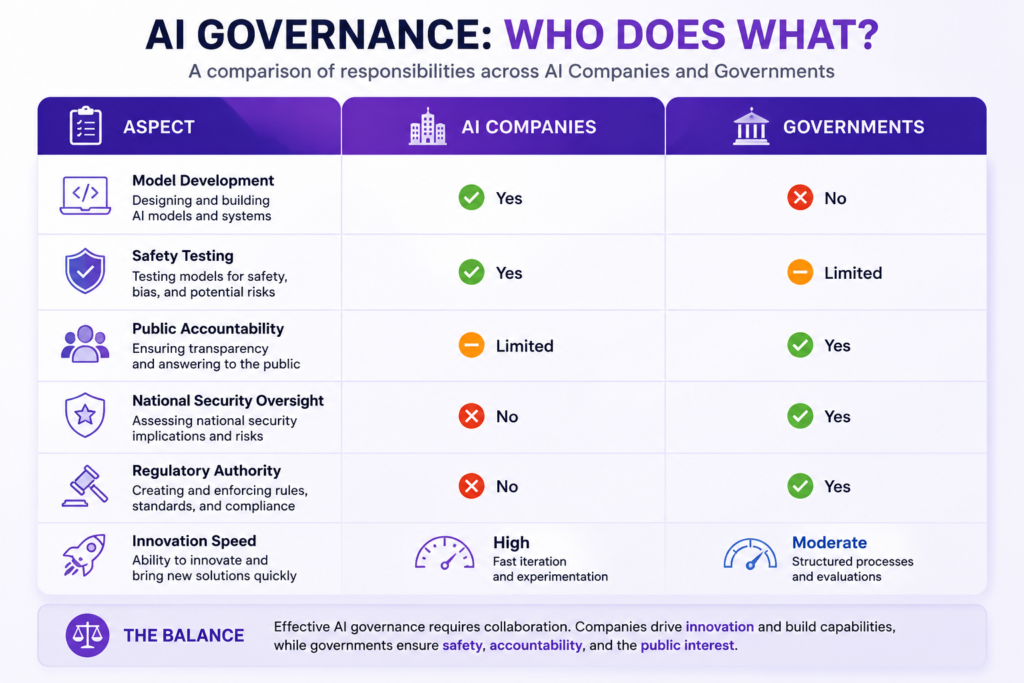
This is no longer just a technology debate. It’s a larger governance and accountability debate.
- Who defines acceptable risk?
- Who sets safety thresholds?
- Who decides how and where AI can be deployed?
- And what happens when governments and companies disagree?
This matters because the implications go beyond policy, they directly impact how organisations will operate.
For businesses, AI strategy is no longer just about capability. It’s about resilience in an increasingly controlled landscape.
- How dependent are we on a single provider?
- What happens if access changes overnight?
- How do we operate when availability itself becomes constrained or controlled?
For years, we assumed progress meant more access, more openness, more scale.
That assumption may be shifting.
What the Future of AI Governance Could Look Like
As governments become more involved in AI oversight and technology companies continue to push the boundaries of innovation, experts expect several key developments:
- Stronger AI regulations
- Increased transparency requirements
- Independent safety audits
- International AI standards
- Greater accountability for AI providers
The future of AI may depend not only on technological advancement but also on how effectively governments and companies collaborate to balance innovation, safety, and public trust.
Because the future of AI may be shaped less by how intelligent our models become,
and more by how deliberately we govern them.
Conclusion
The question is no longer whether AI should be regulated, but how regulation should be implemented. As AI becomes more powerful and deeply integrated into society, determining who gets to decide when AI is “safe enough” will remain one of the most important technology debates of the decade.
The answer will likely require a careful balance between innovation, accountability, national security, and public trust. How governments, businesses, and technology providers navigate this challenge could shape the future of AI for years to come.
What do you think?
Should AI safety decisions remain primarily with the companies building these systems, or should governments play a larger role in determining how advanced AI is developed, deployed, and accessed?
FAQs
What is AI governance?
AI governance refers to the policies, regulations, and frameworks used to ensure artificial intelligence systems are developed and deployed responsibly.
Why is AI safety important?
AI safety helps minimize risks such as misinformation, bias, privacy violations, and cybersecurity threats.
Who regulates artificial intelligence?
Depending on the country, AI may be regulated by governments, independent agencies, industry bodies, or a combination of all three.
How does AI regulation affect businesses?
Regulation may impact AI adoption, compliance requirements, data management practices, and access to advanced AI systems.
What is responsible AI?
Responsible AI focuses on transparency, fairness, safety, accountability, and ethical use of artificial intelligence technologies.